
Supply chain constraints will keep plaguing automobile companies even though demand significantly improved resulting in a 13 per cent year-on-year (YoY) increase in sales in financial year 2021-22 (FY22). Executives at auto firms fear that the Russia-Ukraine war will further dent the sector's prospects of recovery as supply chains face more disruptions. "The visibility in the supply side is so hazy that it is difficult to give even one quarter projection. But all the parameters of demand like pending bookings and enquiries are increasing.

Clock 11% growth in the first 11 months of 2022.

Tata Motors has halved the volume outlook for its UK subsidiary Jaguar Land Rover Automotive (JLR) and warned of lower earnings as it sees the semiconductor shortage deepening in the September quarter of the current financial year, according to a notification issued by the company to the stock exchanges on Tuesday. The announcement caught investors unawares. They were hoping for a quicker recovery. Tata Motors' stock tanked 13 per cent (on July 6) from the day's high of Rs 358.10 and hit the lower circuit (Rs 311.45) in intra-day trades.

Dealers across brands are slashing prices by Rs 20,000 to over Rs 1 lakh, depending on the car model.
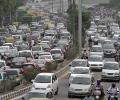
Shortage of semiconductors, price hikes pull January auto sales into red. Dec had seen sales grow for 1st time this FY, which dealers called a one-off.

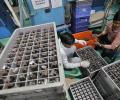
The automobile sector is considered a good indicator of economic health. It has a very long value chain, from primary materials, like metals, glass and plastic, to value-added high-end electronic components, specialised alloys, and software.

The S&P BSE Sensex plunged 128 points to end at 25,102.
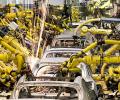
The passenger vehicle dispatches to dealers increased by 11 per cent in July as improvement in semiconductor supplies helped the companies to ramp up production ahead of the festive season, auto dealers' body SIAM said on Friday. Overall passenger vehicle wholesales increased to 293,865 units last month compared to 264,442 units in July 2021. Passenger car dispatches rose 10 per cent to 143,522 units in July from 130,080 units in the year-ago period.

Maruti Suzuki is set to launch a new multi-purpose vehicle (MPV) -- Invicto -- next month. It will be the company's first passenger vehicle with an ex-showroom price tag of Rs 20 lakh or more, said Shashank Srivastava, executive director (sales), on Tuesday. The upcoming MPV will compete with the likes of Toyota Innova Hycross, Kia Carnival, Hyundai Alcazar, MG Hector Plus, Tata Safari, Mahindra & Mahindra XUV700, and Mahindra & Mahindra Scorpio-N - all having three rows of seats. Invicto will be based on the Hycross by Toyota, which will manufacture Maruti's most expensive car at its Bidadi plant in Karnataka.
Vedanta group chairman, Anil Agarwal, 69, is well known for his business journey from a scrap dealer from Bihar to a London-based globe-girdling metal and oil and gas conglomerate with revenues of $19 billion. Now his abilities to keep his group from over-leveraging itself will be put to the test. Over the years, Agarwal, now based in London, set up the conglomerate via acquiring iron ore producer Sesa Goa, Cairn's oil producing assets in India, and Electrosteel Steel.

The Russian-Ukraine war can hit the global supply chains that are already constrained due to the pandemic and the worst impact will be on ongoing chip shortage because the warring nations brutally control supplies of key raw materials that go into making semiconductors, warns a report. Since Russia controls as much as 44 per cent of global palladium suppplies, Ukraine produces a significant 70 per cent of the global supply of neon -- the two key raw materials that go into making chips. The markets can expect the global chip shortage, that began with the pandemic, to worsen if the military conflict lingers on, says a Moody's Analytics report on Friday.

Passenger vehicle majors like Hyundai, Tata Motors, M&M, Toyota Kirloskar and Honda on Wednesday reported growth in domestic sales in August riding on festive sentiments, although market leader Maruti Suzuki posted a decline amid a semiconductor shortage affecting the industry. The country's largest carmaker Maruti Suzuki India Ltd (MSIL) reported domestic sales at 110,080 units, as compared to 116,704 units in the same month last year, down 6 per cent. "Sales volume of the company in August 2021 was affected due to electronic components shortage.
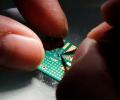
Leading microchip providers Qualcomm and Intel say the chip shortage might last anything between four months to a year, perhaps even two years, depending on the various product categories - mobile devices, ICE, electric vehicles, appliances, data centres. Prakash Mallya, MD, Intel India and vice president, sales and marketing and communications group, said the spike in demand was huge, and cut across segments from PCs, phones, appliances and auto leading to the shortage.
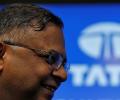
The Tata group is planning to invest $90 billion in new industries such as mobile components plant, semiconductor, electric vehicles, batteries, renewables energy and e-commerce by 2027. The Tata group's investment in India is far higher than the $75-billion investments planned by Mukesh Ambani-owned Reliance Industries and $55-billion investment planned by the Adani group in the next five years in the country, the Economist reported recently. The investment by the Tata group is a shift in its strategy to focus more in the home markets instead of international markets where the group lost money.

Maruti Suzuki India will increase the prices of its vehicles 'substantially' from next month as it looks to offset the impact of rising input costs and make provisions to update the model range to conform to stricter emission norms which kick in from April 2023. In a regulatory filing on Friday, the country's largest carmaker said it continues to witness increased cost pressure driven by overall inflation and recent regulatory requirements. While the automaker makes maximum effort to reduce cost and partially offset the increase, it has become imperative to pass on some of the impact through a price increase, it added.
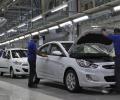
Automakers Maruti Suzuki, Tata Motors, Mahindra & Mahindra and Kia reported robust growth in their vehicle dispatches in the domestic market for August buoyed by festive demand and easing of semiconductor shortage woes. Other manufacturers like Hyundai, Toyota and Skoda also reported growth in wholesales in August as compared with the same month last year. The country's largest automaker Maruti Suzuki India said its domestic passenger vehicle dispatches increased by 30 per cent to 134,166 units in August as compared with 103,187 units in the year-ago month.

The engineering and construction (E&C) sector delivered an excellent performance in the last two financial years (FY2021-22 or FY22 and FY23's nine-months) and there's reason to believe that FY24 will also see outperformance. The sector has emerged from the pandemic with stronger balance sheets and more rational cost structures. It has a big order book and it should see new order flows accelerate in FY24.
Input shortages and low inventories, according to Nomura, will likely lead to production cuts and delayed shipments in the September 2021 quarter.

India can become the number one automotive manufacturing hub in the world within five years, but auto companies need to enhance safety features to reduce deaths due to road accidents, Union Minister Nitin Gadkari said on Thursday. In his inaugural address at the Auto Expo 2023 here, the minister for road transport and highways asserted that the government's target is to reduce these accidents by 50 per cent before the end of 2024 while asking the auto industry to take suo moto action for road safety as the government doesn't want to make anything mandatory. Gadkari's sentiments were also echoed by Minister of Heavy Industries Mahendra Nath Pandey, who lamented that while India has only 1 per cent of the total overall vehicles, the country accounts for 11 per cent of the total global deaths due to road accidents.

Indian companies are planning to increase investments in the new year to expand capacity, acquire companies, and go on a hiring spree, a survey of top executives showed. They, however, cited rising costs, weak consumer demand, and increasing interest rates as major concerns for 2023 which may impact their plans.

Says that 'challenging business conditions' would remain in current quarter, even as it posted an operating profit of $5.05 billion for December quarter

They are both electronic manufacturing services (EMS) companies, also known as contract manufacturers. One is Taiwan's Foxconn group, the undisputed global number one in this business with revenues of $223 billion. The other is Dixon Technologies, the biggest domestic player with revenues of over Rs 10,500 crore.

Bhavish Aggarwal, the founder of ride-hailing firm Ola who disrupted the electric scooters market in the country, is planning to launch an electric sports car in 2024. The plan will put it in competition with Indian players, such as the Tata group and Mahindra & Mahindra, and global giants like Tesla and Hyundai. Aggarwal, recently, took a group of reporters to the firm's design studio at the Ola campus in Bengaluru where his teams are working on several EVs, including scooters, motorcycles, sedans, and SUVs - and even robotaxis.
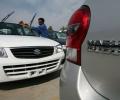
The country's largest carmaker Maruti Suzuki India (MSI) aims to sell 4-6 lakh CNG units in the current fiscal year depending upon supply situation of essential components, as per a senior company official. The company sold about 2.3 lakh CNG units in 2021-22. MSI currently sells nine of its 15 models with CNG powertrain and is looking to drive in more models with such technology in the coming days.

Is self-reliance the right approach in a mega-buck game, or better to be part of a network? asks T N Ninan.

'Bharat has been leading, but it cannot carry India as the bulk of the sales come from India in terms of volume and profitability.'

Maruti was the top gainer in the Sensex pack, rallying over 6 per cent, followed by M&M, Bajaj Auto, NTPC, Reliance Industries and HDFC Bank. NSE Nifty advanced 1.90 points to record 17,855.10.
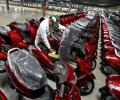
What has hit sentiment further is a draft proposal by the government to increase vehicle insurance premiums for financial year 2022-23 (FY23). Third-party motor insurance premiums have not been increased over the last two years and if this is approved, insurance costs for specific segments could rise by a fifth. The worst impacted is the 350cc and above two-wheeler segment, where premiums are up 21 per cent. Royal Enfield (Eicher Motor) is the market leader in the segment. The premiums in the 150-350cc two-wheeler category are also being inc

The country's largest carmaker Maruti Suzuki India (MSI) on Monday reported a 11.8 per cent increase in wholesales to 164,469 units in February. The company had sold 147,110 units in February last year, Maruti Suzuki India (MSI) said in a statement. Domestic sales increased 11.8 per cent to 1,52,983 units last month, as against 1,36,849 units in February 2020, it added.

TCS was the top gainer in the Sensex pack, rising over 3 per cent, followed by HUL, UltraTech Cement, Nestle India, Kotak Bank, Dr Reddy's and Titan. NSE Nifty surged 157.90 points to 17,234.15.

Ola Electric on Monday said it will foray into the electric car segment with plans to launch its first model by 2024. The company, which struggled with deliveries for its electric scooters after it announced entry into the segment exactly a year ago, has set an ambitious target of selling 10 lakh electric cars by 2026-2027. In a press conference, Ola founder and CEO Bhavish Aggarwal said Ola Electric aims to provide a range of electric two-wheelers to electric cars which are priced in the range of Rs 1 lakh to Rs 50 lakh.

The country's largest carmaker Maruti Suzuki India on Thursday launched a new version of its multi-purpose vehicle XL6 as it gears up to bring a slew of new products this fiscal and take the challenges of prevailing uncertainties head-on. The new XL6 is powered by a 1.5-litre petrol engine with a peak power of 75.8 kW. It is available in manual and automatic transmission options, priced between Rs 11.29 lakh and Rs 14.55 lakh (ex-showroom). Speaking at the launch, newly appointed Maruti Suzuki India managing director and CEO Hisashi Takeuchi said, "With the uncertainties prevailing today, the business realities are continuously evolving.

Mutual fund (MF) houses have started realigning their overseas product offerings after the Securities and Exchange Board of India (Sebi) advised them to stop subscriptions. PPFAS Asset Management has decided to suspend transactions in Parag Parikh Flexi Cap Fund with effect from February 2, 2022. Though new lump-sum and systematic investment plans (SIPs) will not be accepted, existing SIPs and systematic transfer plans (STPs) will continue.
Shortages of chips will impact the car market

N Chandrasekaran, chairman of Tata Consultancy Services (TCS) and Tata Sons, believes that the Digital India Act is a necessity. "The Digital India Act is a necessity because so much has changed over the decades since the original Information Technology (IT) Act was put in place. I am glad the government is developing a participative approach to developing the Digital Act," he said, while answering shareholders at TCS' 27th annual general meeting. Minister of State for Electronics and IT Rajeev Chandrasekhar a few months ago had said that the government would shortly roll out the Digital India Act - a renewed policy for the digital ecosystem and cyberspace in the country.

Recently, TPEM's first born electric concept, Avinya broke cover. The model promises a minimum range of 500 kilometres and advanced technology features, aimed at buyers in India and outside. TPEM, the newly formed entity may also consider a separate dedicated sales channel for the EVs with a distinctive corporate identity once the volumes reach a critical mass and throughput is large enough for the dealers to be profitable, said Chandra. Elaborating further on the hiring strategy he said, "We will hire from everywhere-wherever the talent of the required competency is available."

The first leg of the 35-day festive period, which ended with Dussehra, failed to bring any cheer for auto companies. While makers of passenger vehicles struggled to meet demand due to the persistent shortage of semiconductors, a recovery in demand remained elusive for two-wheeler manufacturers despite offers and schemes. The overall season, which ends two days after Diwali, is unlikely to bring any turnaround in either the supply or the demand scenario, said dealers and officials at auto companies.


'If it is your second car (electric vehicle), you typically keep it for travel within the city.' 'And the first car (internal combustion engine-run vehicles) can then be used to travel to some other cities.'
